For Enquire Call us : 9811631557

Professional Blue Team Operations Program
Advanced Cyber Security & Ethical Hacking – Professional Blue Team Operations Program
Build a Career in Cyber Security, SOC & Blue Team Operations
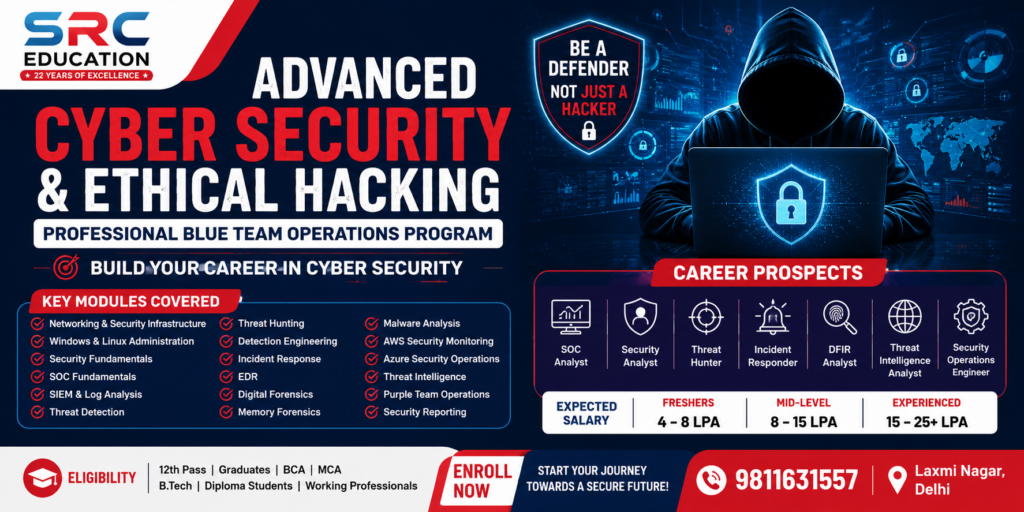
Cyber threats are increasing rapidly, and organizations across industries need skilled professionals who can monitor security systems, detect threats, investigate incidents, and protect critical digital infrastructure. If you want to build a professional career in Cyber Security, SOC Operations, Threat Hunting, Incident Response, Digital Forensics, or Security Operations, the Advanced Cyber Security & Ethical Hacking – Professional Blue Team Operations Program at SRC can help you develop industry-relevant skills.
This advanced program is designed for students, graduates, working professionals, and aspiring cyber security professionals who want to understand how modern security teams identify, analyze, investigate, and respond to cyber threats.
Unlike a basic cyber security course, this program focuses strongly on Blue Team Operations, including Security Operations Center (SOC) fundamentals, SIEM and log analysis, threat detection, threat hunting, incident response, EDR, digital forensics, memory forensics, malware analysis, cloud security monitoring, threat intelligence, and Purple Team operations.
Whether you are starting your career or looking to upgrade your existing IT skills, this program provides a structured learning path toward professional cyber security roles.
Why Learn Cyber Security & Blue Team Operations?
Cyber attacks can affect businesses, financial institutions, educational organizations, healthcare companies, government infrastructure, and almost every organization connected to the internet. Because of this growing threat landscape, organizations require professionals who can continuously monitor their systems and respond to security incidents.
A Blue Team professional works on the defensive side of cyber security. Their responsibilities may include monitoring security alerts, analyzing logs, identifying suspicious activities, investigating incidents, detecting malicious behavior, performing forensic investigations, and improving an organization’s security posture.
The Professional Blue Team Operations Program is designed to provide practical knowledge of these areas and help learners understand how security operations work in real-world environments.
What is Blue Team Operations?
Blue Team Operations refers to the defensive side of cyber security. While offensive security professionals focus on identifying vulnerabilities and simulating attacks, Blue Team professionals focus on detecting, preventing, analyzing, and responding to cyber threats.
A Blue Team may work with:
- Security Information and Event Management (SIEM)
- Endpoint Detection and Response (EDR)
- Security monitoring tools
- Network logs
- Windows and Linux systems
- Threat intelligence platforms
- Digital forensics tools
- Incident response processes
- Malware analysis techniques
- Cloud security monitoring
- Detection engineering
- Threat hunting
The goal is to identify potential attacks as early as possible and minimize their impact on the organization.
Advanced Cyber Security Course at SRC
The Advanced Cyber Security & Ethical Hacking Professional Blue Team Operations Program at SRC is structured to take learners from security fundamentals to advanced defensive security operations.
The course covers technical concepts related to networking, operating systems, security monitoring, SIEM, threat detection, threat hunting, incident response, digital forensics, malware analysis, cloud security, threat intelligence, and Purple Team operations.
Students can develop an understanding of how security teams investigate suspicious activities and respond to security incidents.
Key Modules Covered
1. Networking & Security Infrastructure
A strong understanding of networking is essential for a successful cyber security career. In this module, learners understand networking concepts and security infrastructure required for monitoring and protecting IT environments.
Topics include networking fundamentals, network communication, protocols, infrastructure concepts, network security, and security monitoring.
2. Windows & Linux Administration
Windows and Linux are widely used across enterprise environments. Cyber security professionals need to understand how these operating systems work and how security events are generated.
This module introduces learners to system administration concepts, user management, processes, permissions, services, logs, system configuration, and security monitoring across Windows and Linux environments.
3. Security Fundamentals
Before working with advanced security operations, students need to understand the fundamentals of information security.
The module introduces concepts such as:
- Confidentiality
- Integrity
- Availability
- Authentication
- Authorization
- Access control
- Security threats
- Vulnerabilities
- Risk
- Security controls
These concepts provide the foundation required for advanced cyber security learning.
4. SOC Fundamentals
Security Operations Centers play an important role in modern cyber security. A SOC continuously monitors systems, networks, endpoints, and security alerts.
Students learn about SOC structure, security monitoring, alert management, incident handling, escalation procedures, analyst responsibilities, and security operations workflows.
5. SIEM & Log Analysis
SIEM platforms are widely used by security teams to collect, correlate, and analyze security events.
Students learn how logs are generated and how security professionals analyze events to identify suspicious behavior.
The module covers:
- Log collection
- Log analysis
- Security events
- Event correlation
- Alert investigation
- Security monitoring
- SIEM concepts
- Incident identification
6. Threat Detection
Threat detection involves identifying suspicious activities that may indicate a cyber attack.
Students learn how security teams analyze security events and identify indicators of potentially malicious activity.
The module focuses on understanding detection techniques, security alerts, suspicious behavior, indicators, and investigation workflows.
7. Threat Hunting
Threat hunting is a proactive security activity in which security professionals search for potential threats that may not have triggered traditional security alerts.
Students learn the fundamentals of threat hunting, hypothesis-based investigations, suspicious patterns, indicators of compromise, and investigation techniques.
8. Detection Engineering
Detection engineering focuses on developing and improving security detections.
Students learn how security teams create detection logic based on suspicious behaviors and security indicators. The objective is to improve an organization’s ability to identify threats quickly and accurately.
9. Incident Response
Incident response is an important part of defensive cyber security.
Students learn the basic stages involved in responding to security incidents, including identification, analysis, containment, investigation, remediation, and recovery.
The module helps learners understand how organizations manage security incidents systematically.
10. EDR – Endpoint Detection & Response
Endpoints such as computers, laptops, and servers are common targets for attackers.
EDR solutions help security teams monitor endpoint activities and identify suspicious behavior.
Students learn EDR concepts, endpoint monitoring, suspicious processes, investigation workflows, and response fundamentals.
11. Digital Forensics
Digital forensics involves collecting and analyzing digital evidence after a security incident.
Students are introduced to forensic investigation concepts, evidence handling, system artifacts, investigation procedures, and analysis techniques.
12. Memory Forensics
Memory forensics involves analyzing volatile memory to identify information that may help during a cyber security investigation.
Students learn the fundamentals of memory analysis and understand how investigators can use memory artifacts during incident investigations.
13. Malware Analysis
Malware analysis helps security professionals understand the behavior and characteristics of malicious software.
Students learn the fundamentals of malware analysis, malware behavior, indicators, analysis processes, and defensive investigation techniques.
14. AWS Security Monitoring
Cloud environments require specialized security monitoring. This module introduces learners to security monitoring concepts within AWS environments.
Students understand cloud security fundamentals, monitoring concepts, security events, and how cloud infrastructure can be observed from a security operations perspective.
15. Azure Security Operations
Microsoft Azure is widely used by organizations for cloud infrastructure and enterprise applications.
This module introduces Azure security operations concepts and helps learners understand security monitoring, investigation, and operational security within cloud environments.
16. Threat Intelligence
Threat intelligence helps organizations understand cyber threats, attackers, indicators, and emerging risks.
Students learn the fundamentals of collecting, analyzing, and using threat intelligence to support security monitoring and investigations.
17. Purple Team Operations
Purple Team operations bring offensive and defensive security teams together to improve detection and response capabilities.
Students understand how attack simulations and defensive monitoring can work together to improve security controls and detection mechanisms.
18. Security Reporting
Security professionals need to communicate technical findings clearly.
This module introduces students to security reporting, incident documentation, investigation findings, observations, and professional communication.
Skills You Can Develop
After completing the program, learners can develop knowledge and practical understanding in areas such as:
- Cyber security fundamentals
- Network security
- Windows security
- Linux security
- SOC operations
- SIEM
- Log analysis
- Threat detection
- Threat hunting
- Detection engineering
- Incident response
- EDR
- Digital forensics
- Memory forensics
- Malware analysis
- Cloud security monitoring
- AWS security
- Azure security operations
- Threat intelligence
- Purple Team operations
- Security reporting
These skills can help learners prepare for different entry-level and advanced opportunities in the cyber security domain.
Career Prospects After Cyber Security Training
Cyber security offers multiple career paths depending on your skills, specialization, experience, and professional development.
After gaining relevant knowledge and experience, learners can explore roles such as:
SOC Analyst
A SOC Analyst monitors security alerts, investigates suspicious events, analyzes logs, and helps security teams respond to potential threats.
Security Analyst
Security Analysts help organizations identify security risks, monitor systems, investigate incidents, and implement security controls.
Threat Hunter
Threat Hunters proactively search for hidden threats and suspicious activities that may not have been detected by conventional security monitoring.
Incident Responder
Incident Responders investigate and respond to cyber security incidents and help organizations contain and recover from security threats.
DFIR Analyst
DFIR professionals work in Digital Forensics and Incident Response, helping investigate security incidents and analyze digital evidence.
Threat Intelligence Analyst
Threat Intelligence Analysts research cyber threats, analyze indicators and attacker activities, and provide intelligence that can support security operations.
Security Operations Engineer
Security Operations Engineers help design, maintain, and improve security monitoring and operational security systems.
Expected Salary in Cyber Security
Cyber security salaries vary depending on job role, technical skills, certifications, location, organization, and experience.
As an indicative career range:
Freshers: ₹4–8 LPA
Mid-Level Professionals: ₹8–15 LPA
Experienced Professionals: ₹15–25+ LPA
These figures are indicative and actual salaries can vary significantly based on individual skills, experience, job profile, company, and market conditions.
Who Can Join This Cyber Security Course?
The program is suitable for learners from different educational and professional backgrounds.
Eligibility
- 12th Pass Students
- Graduates
- BCA Students
- MCA Students
- B.Tech Students
- Diploma Students
- IT Students
- Working Professionals
- IT Professionals looking to upgrade their skills
- Beginners interested in Cyber Security
A basic understanding of computers can be helpful, while learners with networking, programming, system administration, or IT backgrounds may find it easier to progress through advanced topics.
Why Choose SRC for Cyber Security Training?
Choosing the right training institute can make a major difference when learning a technical field such as cyber security.
At SRC, the Advanced Cyber Security & Ethical Hacking Professional Blue Team Operations Program is designed around important concepts used in modern defensive security operations.
Structured Learning
The course follows a structured learning path, starting from security fundamentals and progressing toward advanced security operations.
Industry-Relevant Topics
Students are introduced to areas such as SOC, SIEM, threat hunting, incident response, EDR, digital forensics, malware analysis, cloud security, and threat intelligence.
Practical-Oriented Approach
Cyber security is a practical field. Understanding concepts is important, but learners also need to understand how those concepts are applied during security monitoring and investigation.
Career-Focused Learning
The program is designed to help students understand different cyber security career paths and the skills associated with professional security roles.
Suitable for Students & Professionals
The course can be considered by students, graduates, IT professionals, and working professionals who want to build or upgrade their cyber security skills.
Start Your Cyber Security Career
Cyber security is not limited to ethical hacking alone. Modern security teams require professionals who can monitor, detect, investigate, analyze, and respond to cyber threats.
If your goal is to build a career as a SOC Analyst, Security Analyst, Threat Hunter, Incident Responder, DFIR Analyst, Threat Intelligence Analyst, or Security Operations Engineer, developing Blue Team skills can provide a strong foundation.
The Advanced Cyber Security & Ethical Hacking – Professional Blue Team Operations Program at SRC brings together security fundamentals, SOC operations, SIEM, threat detection, threat hunting, incident response, EDR, digital forensics, malware analysis, cloud security, threat intelligence, Purple Team operations, and security reporting in one structured program.
Take the next step toward developing professional cyber security skills and understanding how modern security operations work.
Enroll in Advanced Cyber Security & Ethical Hacking – Professional Blue Team Operations Program
Build your technical knowledge.
Develop defensive security skills.
Understand real-world security operations.
Prepare for a career in the growing field of Cyber Security.
Join SRC and start building your Cyber Security career today.
Frequently Asked Questions
Q1. What is the Advanced Cyber Security & Ethical Hacking course?
It is an advanced cyber security training program focused on defensive security and Blue Team Operations. It covers SOC, SIEM, threat detection, threat hunting, incident response, EDR, digital forensics, malware analysis, cloud security, threat intelligence, and related areas.
Q2. Who can join this Cyber Security course?
12th pass students, graduates, BCA, MCA, B.Tech, diploma students, IT learners, and working professionals can join the program.
Q3. Is this course suitable for beginners?
Yes. The program includes security fundamentals and foundational topics before moving toward advanced Blue Team and security operations concepts.
Q4. What career opportunities are available after Cyber Security training?
Depending on skills and experience, learners can explore roles such as SOC Analyst, Security Analyst, Threat Hunter, Incident Responder, DFIR Analyst, Threat Intelligence Analyst, and Security Operations Engineer.
Q5. What is Blue Team in Cyber Security?
Blue Team refers to the defensive side of cyber security. Blue Team professionals monitor systems, detect threats, investigate suspicious activities, respond to incidents, and work to improve an organization’s security posture.
Q6. Does the course cover SOC and SIEM?
Yes. SOC Fundamentals, SIEM & Log Analysis, Threat Detection, Threat Hunting, Incident Response, EDR, and other security operations topics are included in the program.
Q7. Does the program cover Cloud Security?
Yes. The program includes AWS Security Monitoring and Azure Security Operations as part of its cloud security modules.
Q8. What salary can a Cyber Security professional expect?
Salary depends on skills, experience, role, organization, and location. Indicatively, freshers may earn around ₹4–8 LPA, mid-level professionals ₹8–15 LPA, and experienced professionals ₹15–25+ LPA.
Q9. Can working professionals join this program?
Yes. Working professionals who want to upgrade their IT or cyber security skills can consider the program.
Q10. Why should I learn Blue Team Operations?
Blue Team skills are important for organizations that need professionals capable of monitoring security environments, detecting threats, investigating incidents, and improving defensive security capabilities.
Your Journey into Cyber Security Starts Here
The cyber security industry continues to evolve as organizations face increasingly complex digital threats. Building strong fundamentals and developing specialized skills in SOC operations, threat detection, incident response, digital forensics, threat intelligence, and cloud security can help you prepare for a range of professional opportunities.
Join the Advanced Cyber Security & Ethical Hacking – Professional Blue Team Operations Program at SRC and take the next step toward a career in Cyber Security.