For Enquire Call us : 9811631557
FULL STACK DIPLOMA IN DATA SCIENCE WITH AI
FULL STACK DIPLOMA IN DATA SCIENCE WITH AI
Master Data Science, Artificial Intelligence, Machine Learning and Full-Stack Data Technologies
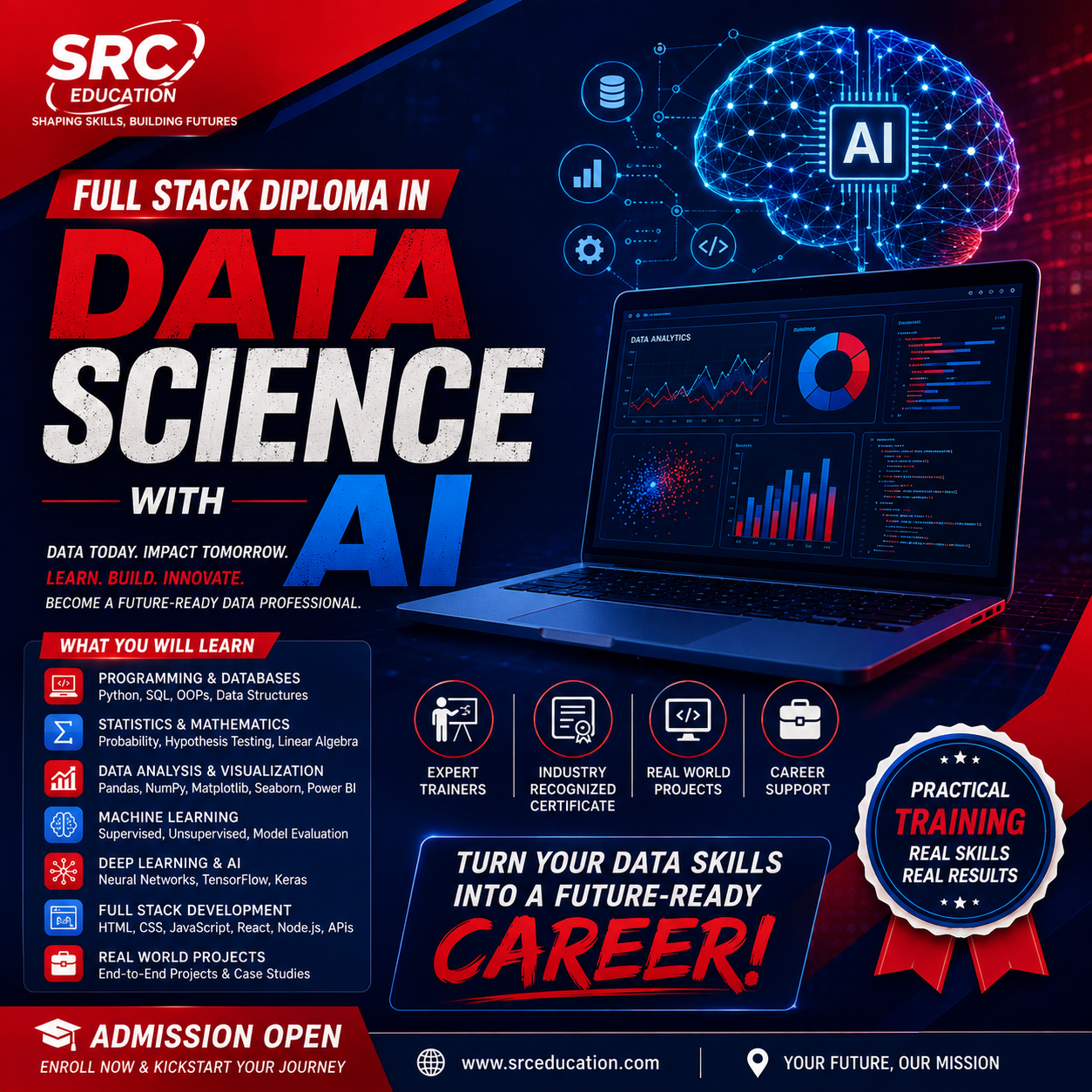
The Full Stack Diploma in Data Science with AI is a comprehensive, career-oriented program designed for students, graduates, working professionals, aspiring data scientists, and technology enthusiasts who want to build strong skills in Data Science, Artificial Intelligence, Machine Learning, Python, Data Analytics, SQL, Data Visualization, Deep Learning, and AI applications.
In today’s technology-driven world, organizations generate enormous amounts of data through websites, applications, transactions, customers, social media, financial systems, and business operations. The ability to collect, process, analyze, and interpret this data has become increasingly important for organizations across industries.
At the same time, Artificial Intelligence is transforming the way businesses operate. AI-powered systems are being used for automation, prediction, recommendation, natural language processing, computer vision, customer support, fraud detection, and many other applications.
The Full Stack Diploma in Data Science with AI is designed to provide learners with an end-to-end understanding of the data science ecosystem. Instead of focusing on only one tool or technology, the program covers the complete journey from data collection and preparation to analysis, machine learning, AI model development, visualization, deployment, and real-world applications.
At SRC Education, the course follows a practical and career-oriented learning approach, helping students develop technical knowledge as well as problem-solving and analytical skills.
What is Full Stack Data Science with AI?
Full Stack Data Science refers to the complete set of skills required to work on a data science project from beginning to end.
A typical data science project can involve:
Data Collection → Data Cleaning → Data Analysis → Data Visualization → Machine Learning → Model Evaluation → AI Applications → Deployment → Monitoring
The Full Stack Diploma in Data Science with AI introduces learners to each of these stages.
Students can learn programming with Python, work with databases using SQL, analyze data using popular libraries, create dashboards and visualizations, build machine learning models, explore deep learning and generative AI, and understand how data science solutions can be deployed.
The objective is to help learners develop a broader understanding of how data science is applied to real-world problems.
Why Choose Full Stack Diploma in Data Science with AI?
Complete Data Science Learning
The program covers multiple areas of data science instead of focusing on a single software tool.
Python-Based Data Science
Python is widely used in data analysis, machine learning, AI, and automation. Students develop Python programming skills for data-related applications.
Artificial Intelligence Integration
Learners explore AI concepts and understand how AI can be applied to modern business and technology problems.
Machine Learning
Students learn how machines can identify patterns in data and make predictions using machine learning algorithms.
Data Analytics
The program covers data cleaning, analysis, visualization, and interpretation.
Database Skills
SQL and database concepts help learners understand how structured data is stored and retrieved.
Practical Projects
Projects allow students to apply technical concepts to realistic datasets and business problems.
Career-Oriented Skills
The program can prepare learners for entry-level opportunities in data analytics, data science, machine learning, AI, and related technology areas.
Who Should Join This Course?
The Full Stack Diploma in Data Science with AI can be suitable for:
- Students interested in Data Science
- Graduates from technical and non-technical backgrounds
- BCA students
- B.Sc. students
- B.Tech students
- MCA students
- Working professionals
- Software professionals
- Data analysts
- Business professionals
- Mathematics and statistics students
- Technology enthusiasts
- Aspiring AI professionals
- Individuals interested in Machine Learning
- Entrepreneurs interested in data-driven business
A basic understanding of computers and mathematics can be helpful, while programming concepts can be learned progressively during the course.
Full Stack Data Science with AI Course Curriculum
Module 1: Introduction to Data Science
Students begin by understanding the complete data science ecosystem.
Topics include:
- Introduction to Data Science
- What is data?
- Types of data
- Data Science lifecycle
- Data-driven decision-making
- Role of a Data Scientist
- Data Analyst vs Data Scientist
- Machine Learning vs AI
- Business applications of Data Science
- Data Science project workflow
Students understand how data science is used to solve real-world problems.
Module 2: Python Programming
Python is one of the most widely used programming languages for Data Science and AI.
Students learn:
- Python fundamentals
- Variables
- Data types
- Operators
- Conditional statements
- Loops
- Functions
- Lists
- Tuples
- Sets
- Dictionaries
- Strings
- File handling
- Exception handling
- Modules and packages
- Object-oriented programming fundamentals
The objective is to develop a strong programming foundation before moving into advanced data science concepts.
Module 3: Python for Data Science
After learning Python fundamentals, students apply Python to data-related tasks.
Topics include:
- NumPy
- Arrays
- Numerical operations
- Pandas
- Series
- DataFrames
- Data filtering
- Data sorting
- Data grouping
- Data transformation
- Data merging
- Data cleaning
Students learn how Python can be used to work with real datasets.
Module 4: Data Cleaning and Preprocessing
Real-world datasets are rarely perfect.
They may contain:
- Missing values
- Duplicate records
- Incorrect formats
- Outliers
- Inconsistent information
- Unnecessary columns
- Data entry errors
Students learn techniques for:
- Handling missing values
- Removing duplicates
- Data transformation
- Data normalization
- Outlier detection
- Data validation
- Feature preparation
Data preprocessing is an important stage before building analytical or machine learning models.
Module 5: Exploratory Data Analysis
Exploratory Data Analysis, or EDA, helps data professionals understand datasets before developing models.
Students learn:
- Data exploration
- Statistical summaries
- Distribution analysis
- Correlation
- Trend analysis
- Pattern identification
- Outlier analysis
- Relationship analysis
- Data interpretation
EDA helps professionals identify useful patterns and potential problems within a dataset.
Module 6: Data Visualization
Data visualization helps transform complex information into understandable visual formats.
Students can learn tools and concepts related to:
- Matplotlib
- Seaborn
- Charts
- Graphs
- Bar charts
- Line charts
- Scatter plots
- Histograms
- Heatmaps
- Interactive visualization
- Dashboard concepts
Students learn how to communicate analytical findings visually.
Module 7: Statistics for Data Science
Statistics plays an important role in data analysis and machine learning.
Topics include:
- Mean
- Median
- Mode
- Range
- Variance
- Standard deviation
- Probability
- Distribution
- Sampling
- Correlation
- Regression
- Hypothesis testing fundamentals
- Statistical interpretation
The goal is to help students understand the mathematical concepts behind data analysis.
Module 8: SQL and Database Management
Data scientists and analysts frequently work with databases.
Students learn:
- Database fundamentals
- Relational databases
- Tables
- Rows and columns
- Primary keys
- Foreign keys
- SQL fundamentals
- SELECT
- WHERE
- ORDER BY
- GROUP BY
- Aggregate functions
- JOIN operations
- Subqueries
- Data filtering
- Data retrieval
SQL helps learners access and manipulate structured business data.
Module 9: Advanced SQL for Data Analysis
Students move beyond basic queries and explore analytical SQL concepts.
Topics include:
- Advanced JOINs
- Subqueries
- Common Table Expressions
- Window functions
- Ranking
- Aggregation
- Data segmentation
- Analytical queries
- Performance concepts
These skills can be useful when working with larger business datasets.
Module 10: Machine Learning Fundamentals
Machine Learning is a core component of modern Data Science.
Students learn:
- Introduction to Machine Learning
- Supervised learning
- Unsupervised learning
- Training data
- Testing data
- Features
- Labels
- Model training
- Model evaluation
- Overfitting
- Underfitting
- Model selection
Students understand how machine learning models learn patterns from data.
Module 11: Supervised Machine Learning
Supervised learning is used when historical data contains known outcomes.
Students can explore algorithms such as:
- Linear Regression
- Logistic Regression
- Decision Trees
- Random Forest
- K-Nearest Neighbors
- Support Vector Machines
- Classification
- Regression
Applications may include:
- Sales prediction
- Customer classification
- Risk assessment
- Price prediction
- Customer churn prediction
Module 12: Unsupervised Machine Learning
Unsupervised learning works with datasets where predefined outcomes may not be available.
Students learn concepts such as:
- Clustering
- K-Means
- Hierarchical clustering
- Customer segmentation
- Pattern discovery
- Dimensionality reduction fundamentals
These techniques can help organizations discover hidden patterns within data.
Module 13: Feature Engineering
Feature engineering involves preparing and creating useful variables for machine learning models.
Students learn:
- Feature selection
- Feature transformation
- Encoding categorical variables
- Scaling
- Normalization
- Feature extraction
- Handling missing values
- Creating meaningful features
Good features can significantly influence the performance of machine learning models.
Module 14: Model Evaluation
Building a model is only one part of machine learning.
Students learn how to evaluate model performance using concepts such as:
- Accuracy
- Precision
- Recall
- F1 Score
- Confusion Matrix
- Mean Absolute Error
- Mean Squared Error
- Root Mean Squared Error
- Cross-validation
- Model comparison
Students learn why selecting the right evaluation metric is important for different problems.
Module 15: Deep Learning Fundamentals
Deep Learning is a specialized area of Artificial Intelligence based on neural networks.
Students are introduced to:
- Neural networks
- Artificial neurons
- Layers
- Activation functions
- Training concepts
- Loss functions
- Optimization
- Deep learning applications
Students can understand how neural networks are used for complex AI problems.
Module 16: Natural Language Processing
Natural Language Processing allows computers to work with human language.
Students learn fundamentals such as:
- Text processing
- Tokenization
- Stop words
- Stemming
- Lemmatization
- Text classification
- Sentiment analysis
- Text representation
- NLP applications
Applications include chatbots, sentiment analysis, document classification, and text-based AI systems.
Module 17: Computer Vision
Computer Vision focuses on enabling machines to interpret visual information.
Students are introduced to:
- Image processing
- Image classification
- Object detection concepts
- Image recognition
- Computer vision applications
- AI-based image analysis
Computer vision is used in areas such as healthcare, manufacturing, security, retail, and autonomous systems.
Module 18: Generative AI
Generative AI has become an important area of modern Artificial Intelligence.
Students explore:
- Generative AI fundamentals
- Large Language Models
- AI-generated text
- Prompt engineering
- AI-assisted coding
- AI-assisted data analysis
- AI content generation
- AI productivity
- Responsible AI usage
Students learn how generative AI can support modern data science and technology workflows.
Module 19: Prompt Engineering
Effective interaction with AI systems requires clear instructions.
Students learn:
- Prompt fundamentals
- Prompt structure
- Context
- Role-based prompting
- Instruction design
- Structured outputs
- Prompt optimization
- AI-assisted analysis
- AI-assisted programming
The objective is to help learners communicate effectively with AI tools.
Module 20: AI and Data Science Automation
AI can assist with repetitive and time-consuming data-related tasks.
Students explore AI applications in:
- Data exploration
- Code assistance
- Data cleaning
- Documentation
- Data summaries
- Visualization ideas
- Report generation
- Analytical workflows
- Productivity automation
AI-generated results should always be reviewed and validated before being used for important decisions.
Module 21: Power BI and Business Intelligence
Data science professionals often need to communicate findings to business teams.
Students can learn:
- Power BI fundamentals
- Data import
- Data transformation
- Data modeling
- Relationships
- Measures
- Visualizations
- Filters
- Slicers
- Dashboards
- Reports
- Business KPIs
Power BI can help convert analytical information into interactive business dashboards.
Module 22: Data Science Projects
Practical projects form an important part of the program.
Students can work on projects such as:
Sales Prediction
Analyze historical sales data and develop a model to estimate future sales.
Customer Churn Prediction
Analyze customer behavior and identify customers who may be likely to leave a service.
Customer Segmentation
Use clustering techniques to divide customers into meaningful groups.
House Price Prediction
Build a regression model using property-related features.
Sentiment Analysis
Analyze text data and classify customer opinions or reviews.
Recommendation System
Explore how recommendation systems can suggest relevant products or content.
Business Dashboard
Create an interactive dashboard to monitor important business KPIs.
Module 23: Model Deployment Fundamentals
A machine learning model becomes more useful when it can be made available for practical applications.
Students are introduced to:
- Model deployment concepts
- APIs
- Web applications
- Model serving
- Basic deployment workflows
- Application integration
- Model monitoring fundamentals
Students understand the basic journey from developing a model to making it accessible through an application.
Module 24: Full Stack Data Science Workflow
The final stage combines the skills learned throughout the program.
Students understand an end-to-end workflow:
Data Collection
↓
Data Storage
↓
Data Cleaning
↓
Exploratory Data Analysis
↓
Data Visualization
↓
Feature Engineering
↓
Machine Learning
↓
AI Model Development
↓
Model Evaluation
↓
Deployment
↓
Monitoring and Improvement
This complete workflow helps learners understand how different Data Science technologies work together.
Skills You Can Develop
After completing the Full Stack Diploma in Data Science with AI, learners can develop skills in:
- Python
- Data Science
- Data Analytics
- SQL
- Database management
- NumPy
- Pandas
- Data cleaning
- Data preprocessing
- Exploratory Data Analysis
- Data visualization
- Statistics
- Machine Learning
- Deep Learning fundamentals
- Natural Language Processing
- Computer Vision fundamentals
- Generative AI
- Prompt Engineering
- Power BI
- Business Intelligence
- Model evaluation
- AI-assisted analytics
- Model deployment fundamentals
- Problem-solving
- Analytical thinking
Career Opportunities After the Course
Depending on their qualifications, practical skills, projects, experience, and employer requirements, learners can explore roles such as:
Data Scientist
Data Scientists analyze large datasets, build predictive models, identify patterns, and develop data-driven solutions.
Junior Data Scientist
Entry-level Data Scientists support data preparation, analysis, visualization, and machine learning projects.
Data Analyst
Data Analysts collect, clean, analyze, and visualize data to support business decisions.
Machine Learning Engineer
Machine Learning Engineers work on developing, testing, and deploying machine learning solutions.
AI Engineer
AI Engineers work with Artificial Intelligence technologies to develop intelligent applications and systems.
Business Intelligence Analyst
BI Analysts create dashboards, reports, and analytical solutions to support business decision-making.
Python Developer
Python Developers build software, automation solutions, data applications, and backend systems using Python.
Data Science Associate
Data Science Associates support data preparation, research, analysis, reporting, and model development.
Machine Learning Analyst
These professionals work with machine learning workflows, datasets, model evaluation, and analytical tasks.
Industries Using Data Science and AI
Data Science and AI are being applied across a wide range of industries, including:
- Information Technology
- Banking and Finance
- Healthcare
- E-commerce
- Retail
- Education
- Manufacturing
- Telecommunications
- Logistics
- Insurance
- Marketing
- Real Estate
- Automotive
- Media
- Travel and Hospitality
- Cybersecurity
- Consulting
- Startups
The exact career opportunities vary according to industry, employer requirements, qualifications, and experience.
Practical Learning Approach
Data Science is a highly practical field. Reading concepts alone is not enough to develop strong analytical and technical skills.
At SRC Education, students can gain hands-on exposure through:
- Python programming exercises
- SQL assignments
- Data cleaning activities
- Data analysis projects
- Visualization exercises
- Machine learning projects
- AI experiments
- Dashboard development
- Business case studies
- Capstone projects
- Model evaluation
- AI-assisted workflows
Working with datasets and practical problems helps students understand how theoretical concepts are applied in real-world situations.
Capstone Project
A final capstone project can bring together multiple skills learned during the program.
Students can work through a complete project involving:
- Problem identification
- Data collection
- Data cleaning
- Exploratory analysis
- Data visualization
- Feature engineering
- Model development
- Model evaluation
- AI integration
- Dashboard or application development
- Project documentation
- Presentation
This type of project can help students demonstrate their technical and analytical capabilities.
Why Choose SRC Education?
Full-Stack Curriculum
The program covers programming, analytics, databases, machine learning, AI, visualization, and deployment fundamentals.
Practical Training
Students can work with datasets, coding exercises, projects, and real-world business scenarios.
AI-Focused Learning
Artificial Intelligence and Generative AI concepts are integrated into the learning journey.
Industry-Relevant Technologies
Learners can gain exposure to Python, SQL, Power BI, machine learning libraries, and other data technologies.
Project-Based Learning
Practical projects help students demonstrate what they have learned.
Career-Oriented Approach
The course focuses on building technical, analytical, and professional skills relevant to modern data careers.
Frequently Asked Questions
What is a Full Stack Diploma in Data Science with AI?
It is a comprehensive professional program covering the complete Data Science workflow, including Python, SQL, data analytics, visualization, machine learning, AI, deep learning fundamentals, Generative AI, and deployment concepts.
Is this course suitable for beginners?
Yes. The program can begin with Python and data fundamentals before progressing toward machine learning and Artificial Intelligence.
Do I need programming knowledge?
Previous programming experience can be helpful but is not necessarily required. Python fundamentals can be learned as part of the program.
Is Mathematics required for Data Science?
Basic mathematics and statistics are useful for understanding Data Science. The course can introduce learners to the statistical concepts required for analytics and machine learning.
Which programming language is used?
Python is a major programming language used throughout Data Science and AI training.
Is SQL included?
Yes. SQL and database concepts are important parts of the Data Science workflow and can be included in the program.
Is Machine Learning included?
Yes. The curriculum covers supervised and unsupervised learning, algorithms, feature engineering, and model evaluation.
Is Artificial Intelligence included?
Yes. AI fundamentals, Generative AI, NLP, Computer Vision fundamentals, and AI-assisted workflows are included.
Can I become a Data Scientist after completing the course?
The program can help build foundational and practical skills relevant to Data Science. Becoming job-ready also depends on your projects, technical ability, qualifications, experience, portfolio, and employer requirements.
Can I work as a Data Analyst?
Yes. The program includes data analysis, Excel/Power BI concepts, SQL, Python, visualization, and reporting skills that are relevant to Data Analyst roles.
Are projects included?
Practical projects can include sales prediction, customer segmentation, churn prediction, sentiment analysis, dashboards, and other real-world Data Science applications.
Build Your Future with Data Science and AI
Data Science and Artificial Intelligence are changing the way organizations understand information, solve problems, automate processes, and make decisions.
The Full Stack Diploma in Data Science with AI is designed to give learners an end-to-end understanding of the technologies involved in this rapidly evolving field.
From Python and SQL to Data Analytics, Machine Learning, Deep Learning, Generative AI, Data Visualization, and deployment, students can develop a broad technical foundation and apply their knowledge through practical projects.
Whether your goal is to become a Data Analyst, Data Scientist, Machine Learning Professional, AI Professional, Business Intelligence Analyst, or Python Developer, this program can provide a strong foundation for building your career in data and Artificial Intelligence.
Start Your Data Science Journey
Learn how to work with data, develop intelligent models, understand AI technologies, and solve real-world problems through practical Data Science.
Learn Data. Build AI. Create Intelligent Solutions.
Contact SRC Education to learn more about the Full Stack Diploma in Data Science with AI, eligibility, duration, fees, batch timings, and admission process.