For Enquire Call us : 9811631557
DATA STRUCTURES COURSE IN LAXMI NAGAR – SRC EDUCATION
Learn Data Structures with Practical Programming
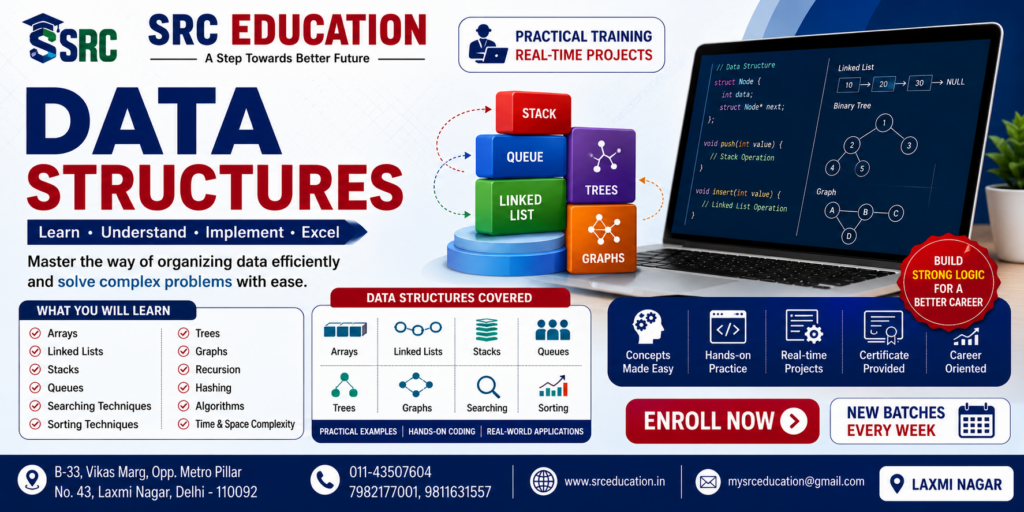
Data Structures are one of the most important concepts in computer programming and software development. They provide an organized way to store, manage, process, and access data efficiently. A strong understanding of Data Structures helps students improve their programming logic and problem-solving abilities.
SRC Education offers a practical and career-oriented Data Structures Course in Laxmi Nagar for students, beginners, graduates, BCA/MCA students, computer science learners, and aspiring software developers.
The course focuses on understanding different data structures, their operations, applications, and implementation concepts. Students learn how different structures can be used to solve programming problems efficiently.
Introduction to Data Structures
The course starts with the fundamental concepts of Data Structures.
Students learn:
- What is Data?
- What is a Data Structure?
- Need for Data Structures
- Types of Data Structures
- Linear Data Structures
- Non-Linear Data Structures
- Static and Dynamic Data Structures
- Basic operations on Data Structures
- Data organization and processing
Understanding these fundamentals helps students build a strong foundation before moving toward advanced structures.
Arrays
Arrays are one of the basic and widely used data structures. They allow multiple values of similar types to be stored in an organized manner.
At SRC Education Laxmi Nagar, students learn:
- Introduction to Arrays
- One-dimensional Arrays
- Two-dimensional Arrays
- Multidimensional Arrays
- Array traversal
- Insertion
- Deletion
- Searching
- Updating elements
- Array-based problem solving
Students practice different programming problems using arrays to improve their logical thinking.
Strings
Strings are commonly used for storing and processing textual information.
The Data Structures training introduces concepts related to:
- String representation
- String operations
- Character processing
- Searching within strings
- Manipulating strings
- String-based programming problems
These concepts help learners understand how textual data can be stored and processed.
Linked Lists
Linked Lists are an important dynamic data structure. Unlike arrays, linked lists can dynamically organize elements through connected nodes.
Students learn the basic concepts of:
- Linked List
- Nodes
- Pointers/References
- Creating a linked list
- Traversing a linked list
- Insertion
- Deletion
- Searching
- Updating nodes
The course also introduces different types of linked lists.
Types of Linked Lists
Students can learn:
- Singly Linked List
- Doubly Linked List
- Circular Linked List
Practical exercises help learners understand how linked lists work internally and where they can be useful.
Stacks
A Stack is a linear data structure based on the LIFO (Last In, First Out) principle.
Students learn:
- Introduction to Stack
- Stack operations
- Push
- Pop
- Peek/Top
- Stack implementation
- Applications of Stack
Stack concepts are useful for understanding many programming and algorithmic problems.
Queues
Queue is another important linear data structure that generally follows the FIFO (First In, First Out) principle.
The course covers:
- Introduction to Queue
- Queue operations
- Enqueue
- Dequeue
- Front and Rear
- Queue implementation
- Applications of Queue
Students also understand different variations of queues.
Types of Queues
- Simple Queue
- Circular Queue
- Priority Queue
- Double-Ended Queue (Deque)
Searching Techniques
Searching is an important operation performed on data structures. Students learn how to locate specific elements within a collection of data.
The course introduces:
- Searching concepts
- Linear Search
- Binary Search
- Search efficiency
- Practical searching problems
Students learn how the choice of searching technique can affect program performance.
Sorting Techniques
Sorting involves arranging data in a particular order. It is widely used in programming and data processing.
Students learn different sorting concepts and techniques, including:
- Bubble Sort
- Selection Sort
- Insertion Sort
- Merge Sort
- Quick Sort
Through practical exercises, students understand how different sorting algorithms work and how their approaches differ.
DATA STRUCTURES COURSE – PART 2
Trees
Trees are an important category of non-linear data structures. They organize data in a hierarchical manner.
Students at SRC Education learn the basic concepts of:
- Tree terminology
- Root
- Nodes
- Edges
- Parent and Child Nodes
- Leaf Nodes
- Tree Traversal
Binary Trees
The course introduces Binary Trees and their structure.
Students learn:
- Binary Tree
- Binary Search Tree
- Tree insertion
- Tree searching
- Tree traversal
- Tree deletion concepts
Different traversal techniques are also introduced to help students understand how tree data can be processed.
Graphs
Graphs are non-linear data structures used to represent relationships and connections between different elements.
Students learn:
- Introduction to Graphs
- Vertices
- Edges
- Directed Graphs
- Undirected Graphs
- Graph representation
- Graph traversal
- Applications of Graphs
Graphs are useful in understanding networks, connections, routes, and relationship-based problems.
Recursion
Recursion is an important programming technique where a function calls itself to solve a problem.
Students learn:
- Introduction to Recursion
- Recursive functions
- Base condition
- Recursive calls
- Problem solving using recursion
Recursion is particularly useful when working with structures such as trees and certain algorithmic problems.
Hashing
Hashing provides a technique for storing and retrieving information efficiently.
Students are introduced to:
- Hashing concepts
- Hash Functions
- Hash Tables
- Key-value concepts
- Searching using hashing
- Collision concepts
This helps learners understand how efficient data access can be achieved.
Algorithms & Complexity
Data Structures are closely connected with algorithms. Students learn how algorithms can be designed to solve programming problems.
The course introduces:
- Algorithms
- Algorithm efficiency
- Time Complexity
- Space Complexity
- Best Case
- Worst Case
- Average Case
- Big-O notation
Understanding complexity helps students evaluate how efficiently a program or algorithm performs.
Data Structures with Programming
At SRC Education, Laxmi Nagar, students learn how Data Structures can be implemented through programming.
The practical approach focuses on:
- Writing programs
- Implementing data structures
- Solving logical problems
- Debugging programs
- Understanding algorithmic logic
- Comparing different approaches
Students can practice concepts using programming languages they are learning or have previously studied.
Practical Data Structures Projects
Project-based learning helps students apply theoretical concepts to practical programming problems.
Possible practice projects include:
- Student Record Management
- Contact Management System
- Stack-Based Application
- Queue Management System
- Searching and Sorting Application
- Linked List Application
- Data Processing Programs
These exercises help learners combine multiple Data Structures concepts within practical applications.
Who Can Join Data Structures Course?
The course at SRC Education is suitable for:
- BCA Students
- MCA Students
- B.Sc. CS/IT Students
- Computer Science Students
- IT Students
- Programming Beginners
- College Students
- Graduates
- Freshers
- Job Seekers
- Aspiring Software Developers
Career Benefits of Learning Data Structures
A strong understanding of Data Structures can help students prepare for programming and software development roles.
It can support learning for roles such as:
- Software Developer
- Junior Software Developer
- Programmer
- Application Developer
- Backend Developer
- Coding Professional
- Software Engineer
Data Structures also form an important foundation for technical interviews and competitive programming.
Why Choose SRC Education?
SRC Education, Laxmi Nagar provides practical and career-focused computer training designed to help students strengthen their technical skills.
Key Benefits
- Structured Data Structures Training
- Practical Programming
- Algorithmic Problem Solving
- Searching & Sorting
- Arrays & Linked Lists
- Stack & Queue
- Trees & Graphs
- Recursion
- Complexity Analysis
- Practical Exercises
- Project-Based Learning
- Career-Oriented Training
Data Structures Course in Laxmi Nagar
If you are searching for a Data Structures Course in Laxmi Nagar, SRC Education provides structured training covering fundamental as well as advanced Data Structures concepts.
From Arrays and Linked Lists to Stacks, Queues, Trees, Graphs, Searching, Sorting, Recursion, Hashing, and Algorithm Complexity, students can develop a strong foundation in data organization and problem solving.
Start Learning Data Structures with SRC Education
SRC Education
B-33, Vikas Marg, Opp. Metro Pillar No. 43, Laxmi Nagar, Delhi – 110092
Phone: 011-43507604 | 7982177001 | 9811631557
Website: www.srceducation.in
Email: mysrceducation@gmail.com
I prefer this response