For Enquire Call us : 9811631557
JAVA TECHNOLOGY COURSE IN LAXMI NAGAR – SRC EDUCATION
Java Technology & Core Java Java Technology Course in Laxmi Nagar
Java is a powerful, versatile, and widely used programming language that is used for developing software applications, enterprise solutions, web-based applications, desktop applications, and various technology-driven systems. Its object-oriented programming approach makes Java an important language for students who want to build a career in software and application development.
SRC Education, Laxmi Nagar offers a structured and practical Java Technology Course designed for students, graduates, freshers, BCA/MCA learners, computer science students, IT students, and aspiring software developers.
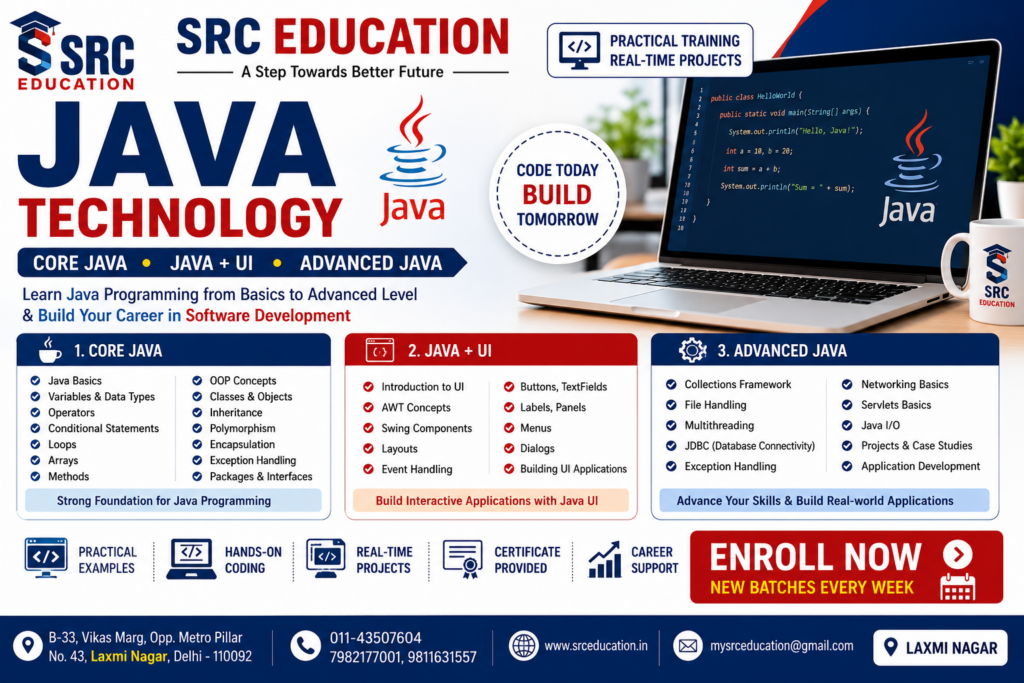
The Java Technology training is organized into three major learning areas:
- Core Java
- Java + UI
- Advanced Java
This structured learning path helps students begin with programming fundamentals and gradually progress toward advanced Java development concepts.
Why Learn Java?
Java helps students develop strong programming logic and understand object-oriented programming concepts. It is also useful for learners who want to continue toward software development and other technology specializations.
Learning Java can help students understand:
- Programming fundamentals
- Object-oriented programming
- Application development
- Problem-solving techniques
- Data handling
- User interface concepts
- Advanced programming concepts
- Practical software development
At SRC Education, the learning approach focuses on understanding concepts and applying them through programming practice.
Core Java
Core Java is the foundation of the Java Technology Course. Students first learn the fundamental concepts of Java programming before moving toward UI and advanced Java topics.
Introduction to Java
Students begin by understanding Java and its role in software development.
The introductory module covers:
- Introduction to Java
- Features of Java
- Java environment
- Java program structure
- Java syntax
- Compilation and execution
- Basic programming concepts
Students learn how Java programs are written, compiled, and executed.
Java Programming Fundamentals
The course introduces the basic building blocks required for writing Java programs.
Students learn about:
- Variables
- Constants
- Data types
- Operators
- Expressions
- Input and output
- Type conversion
- Basic program structure
Practical exercises help students understand how individual programming concepts work together.
Conditional Statements
Decision-making is an important part of programming. Students learn how Java programs can perform different operations according to specific conditions.
Topics include:
- If statement
- If-else
- Nested conditions
- Multiple conditions
- Logical operators
- Relational operators
- Decision-making programs
Students practice different problems to improve their programming logic.
Loops in Java
Loops are used to execute a particular set of instructions repeatedly.
The course introduces:
- For loop
- While loop
- Do-while loop
- Nested loops
- Loop control
- Repetitive programming
Students practice loop-based programs and learn how iteration can simplify programming tasks.
Arrays in Java
Arrays are used to store multiple values in an organized structure.
Students learn:
- One-dimensional arrays
- Multidimensional arrays
- Array declaration
- Array initialization
- Array traversal
- Searching in arrays
- Updating array elements
- Array-based programming problems
These concepts provide a foundation for handling collections of data.
Object-Oriented Programming in Java
Object-Oriented Programming is one of the most important parts of Java. At SRC Education Laxmi Nagar, students learn how Java uses objects and classes to create structured and reusable programs.
Important OOP concepts include:
- Classes
- Objects
- Methods
- Constructors
- Encapsulation
- Inheritance
- Polymorphism
- Abstraction
Classes and Objects
Students learn how classes act as templates for creating objects and how objects represent individual instances of a class.
Practical examples help learners understand how real-world entities can be represented through Java programs.
Constructors
Constructors are used for initializing objects. Students learn the purpose of constructors and how they are used while working with classes and objects.
Inheritance
Inheritance allows one class to acquire properties and behaviors from another class.
Students learn the concept of inheritance and how it can help create reusable and organized programs.
Polymorphism
Polymorphism allows a particular operation to behave differently in different situations.
Students learn the basic concepts of polymorphism and understand its importance in object-oriented Java programming.
Encapsulation
Encapsulation helps organize data and methods within classes.
Students understand how data and functionality can be grouped together to create structured applications.
Abstraction
Abstraction focuses on exposing essential functionality while hiding unnecessary implementation details.
Students learn how abstraction contributes to organized application development.
Exception Handling in Java
Errors and unexpected situations can occur during program execution. Java provides exception-handling mechanisms to manage these situations.
Students learn:
- Errors and exceptions
- Exception handling
- Try and catch
- Finally
- Throw and throws
- Handling runtime problems
This helps students understand how Java applications can be made more reliable.
Packages and Interfaces
Students are introduced to packages and interfaces as part of structured Java programming.
Packages help organize Java classes and related components, while interfaces help define a common structure for classes.
These concepts support better organization and reusable application development.
JAVA TECHNOLOGY COURSE – PART 2
Java + UI
After learning Core Java, students can move toward Java + UI, where programming concepts are connected with user interface development.
A user interface allows users to interact with an application through visual elements and controls.
The Java + UI section introduces concepts related to:
- User interface design
- Interface components
- User interaction
- Event handling
- Input controls
- Buttons and forms
- Application screens
- Connecting UI with Java logic
The objective is to help students understand how programming logic can be connected with an interactive application interface.
Java UI Components
Students can work with different interface elements and understand how they are used within applications.
The training focuses on understanding how users provide input, how applications process that input, and how appropriate output can be displayed.
Event Handling
Interactive applications respond to user actions. Students learn the basic concept of event-driven programming and how application components can respond to different events.
This helps learners understand the relationship between the user interface and Java programming logic.
Advanced Java
After developing a foundation in Core Java and Java + UI, students can progress to Advanced Java.
Advanced Java focuses on application-oriented programming and helps learners understand more advanced concepts required for developing structured Java applications.
The Advanced Java module builds upon the concepts learned in Core Java.
Advanced Java Programming
Students learn how Java programming concepts can be applied to more complex application requirements.
The training focuses on:
- Advanced programming concepts
- Application development
- Structured coding
- Data handling
- Application components
- Connecting application modules
- Practical problem solving
Database Connectivity Concepts
Applications often need to store and retrieve information from databases. Advanced Java introduces learners to the concept of connecting applications with data sources.
Students can understand:
- Database concepts
- Application-data interaction
- Storing information
- Retrieving information
- Updating data
- Managing application data
This provides a foundation for understanding database-driven applications.
Web Application Concepts
Advanced Java also introduces learners to concepts related to web-based application development.
Students understand how programming logic can be used within application environments where users interact through web interfaces.
This helps bridge the gap between basic Java programming and application-oriented development.
Practical Java Training at SRC Education
Practical training is an important part of the Java Technology Course at SRC Education.
Students can practice Java programs and gradually develop their programming skills through exercises and application-based tasks.
Practical learning can include:
- Java coding exercises
- OOP-based programs
- Array-based programs
- Exception handling programs
- UI-based exercises
- Application development tasks
- Database-oriented exercises
- Mini projects
The objective is to help learners understand not only what Java concepts are, but also how they can be used in practical programming.
Java Projects
Project-based learning allows students to combine multiple Java concepts.
Students can work on projects such as:
- Student Management System
- Employee Management System
- Library Management System
- Simple Billing Application
- User Registration Application
- Data Management Application
- Java UI Application
Projects can help learners improve coding practice, logical thinking, debugging skills, and application development knowledge.
Who Can Join Java Technology Course?
The Java Technology Course at SRC Education, Laxmi Nagar can be suitable for:
- BCA students
- MCA students
- B.Sc. Computer Science students
- B.Sc. IT students
- Computer Science students
- IT students
- College students
- Graduates
- Freshers
- Programming beginners
- Job seekers
- Aspiring software developers
Students who want to strengthen their programming foundation can start with Core Java and gradually progress toward Java + UI and Advanced Java.
Career Opportunities After Java Training
Java programming skills can be useful for learners interested in software and application development.
Depending on additional skills and specialization, learners can explore opportunities such as:
- Java Developer
- Junior Java Developer
- Software Developer
- Application Developer
- Backend Developer
- Software Engineer
- Programmer
- Web Application Developer
Java can also provide a foundation for learning additional technologies and development frameworks.
Why Choose SRC Education for Java Technology?
SRC Education in Laxmi Nagar focuses on practical and career-oriented computer training.
Key Benefits
- Structured Java Technology Course
- Core Java Training
- Java + UI Training
- Advanced Java Training
- Practical Coding
- Object-Oriented Programming
- Application-Based Learning
- Project Practice
- Programming Logic Development
- Career-Oriented Training
The course follows a progressive learning approach so students can build their knowledge step by step.
Java Technology Course in Laxmi Nagar
If you are searching for a Java Technology Course in Laxmi Nagar, SRC Education provides structured training covering Core Java, Java + UI, and Advanced Java.
The course is designed to help learners build programming fundamentals, understand object-oriented programming, explore user interface concepts, and progress toward advanced Java application development.
Start Learning Java with SRC Education
Build your programming foundation and develop practical Java skills with SRC Education, Laxmi Nagar, Delhi.
SRC Education
B-33, Vikas Marg, Opp. Metro Pillar No. 43, Laxmi Nagar, Delhi – 110092
Phone: 011-43507604 | 7982177001 | 9811631557
Website: www.srceducation.in
Email: mysrceducation@gmail.com